

Lessons from the Past
by Kenneth Lubbock
Excerpts from Charge of the Light Brigade by John Train
The S&P 500 and other leading indexes of the stock market have been advancing, perhaps irregularly, but chalking up successive yearly gains and recent new highs. There are, however, some signs that investors should be skeptical of the story the S&P 500 tells and should restrain any urge to jump into the fray and add to their exposure. John Train, our erstwhile chairman, and our friend, wrote “The Charge of the Light Brigade” for Forbes in 1981, after the art market had produced several successive years of price gains greater than 20%. The following text is extracted from that article. He draws a parallel to the stock market, one that may be applicable today.
“I was talking recently to an art dealer used by several of my client families. “What are the current trends in the art market?” I asked him.
He assumed a grave air. “Well, it’s a good market for the top stuff,” he replied earnestly. “The really first-class pieces move easily. As for the rest, well, it depends.”
I pressed him, and it emerged that auction prices are eroding across the board, masked by strength in a few leaders. The “cowboy and Indians” genre is bouncing right along, fueled by the new class of deregulation millionaires in Oklahoma and Wyoming, but many highflyers of a few years ago aren’t making their reserve prices.
…
Modarco, an art fund sponsored by Banque de Paris et des Pays Bas (Paribas), has gone belly-up; Artemis, sponsored by Baron Leon Lambert, although making money as a gallery—no longer as a fund—is nevertheless only selling at its 1974 issue price; the (Paris) Banque Rothschild’s art portfolio scheme went under; and Poliarco, the (London) Rothschild–Banca della Svizzera Italiana vehicle, is said to be fading fast. Another Swiss-based art fund was scuttled some time back. So the least you can say is that art is not the one-way street that some enthusiasts like to call it.
The fatal error is to be last on board a speculative bandwagon, just before it breaks down. Perhaps that’s where we are now. Art has had a very long run of steady upvaluation, and it can’t go on improving forever.
…
This phenomenon resembles the loss of breadth in the stock market as one approaches a major peak: For a couple of years, from 1971 right into 1973, the breadth of the stock market was falling, as measured by the ratio of advances to declines, even though the Dow was still struggling upward. Then came 1974. [The two-year bear market saw a decline of 45% in the S&P 500.]
This effect, a few new highs masking general erosion, can perhaps be explained by an analogy: the charge of the Light Brigade.
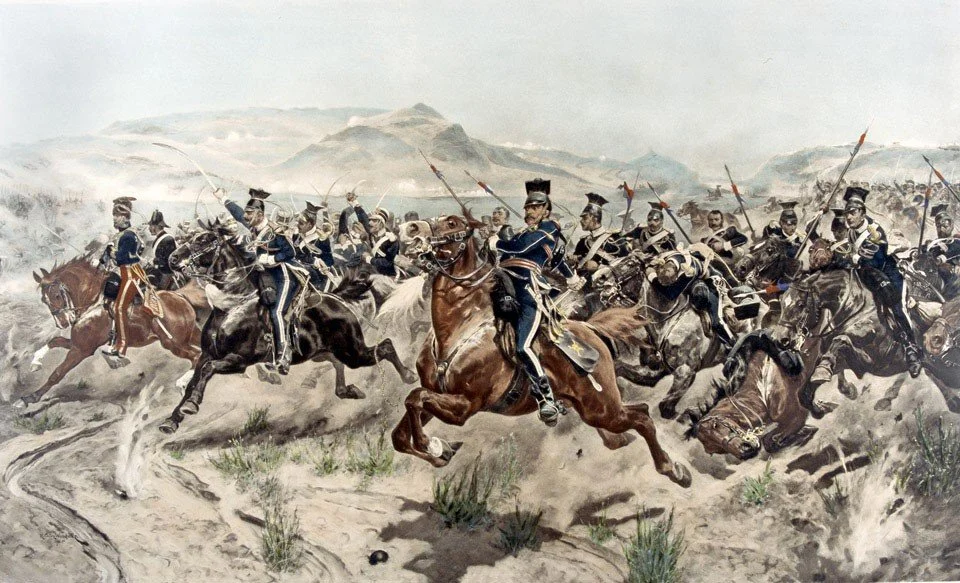
Charge of the Light Brigade by Richard Caton Woodville Jr. , 1894
General Cardigan tucks his helmet-strap under his chin, glances over to see that his color-bearer is keeping up, kicks his horse into a trot, muttering, “Here goes the last of the Brudenells.” His bugler sounds the charge. The whole brigade sweeps forward and is soon enveloped in dust and the roar of artillery fire: “stormed at by shot and shell,” as Tennyson says. From the hill overlooking the valley of death the commander of the army can see the colors advancing through the smoke, marking where General Cardigan has reached in his charge.
But fewer and fewer of his troops are with him. Whole ranks fall to the ground. Finally, almost alone, the General reaches the far end of the valley, passes right through the guns and out the other side, accompanied by his current color-bearer, several earlier ones having been killed. The commander, on his hill overlooking the scene, has known for some time that the charge has failed. The General was still moving forward, but nearly alone. In the end the objective is obtained, but there isn’t any more Light Brigade.
In just the same way, when the dealers tell us that the “top stuff” is still moving, although other items aren’t, we can reasonably conclude that the whole charge is running out of steam. After all, what does the term top stuff mean? Just what’s highest priced at the moment—the latest favorite.
…
So, reader, if at this late date you feel the urge (and have the money) to jump into the fray of the art market, relax, enjoy the view from your hilltop, and see if you don’t get a better deal when the charge has passed and night descends over the battlefield.”
There is, of course, at least one major difference between the stock market and the art market: the value of stocks increases as their earnings power increases, whereas the value of art ultimately lies in the eye of the beholder. However, today, in mid-October 2026, the bond market has declined, pushing long-term yields up to levels not seen for nearly a quarter of a century. Meanwhile, the stock market, as measured by the NASDAQ 100 and S&P 500, has shrugged this off and is within spitting distance of its all-time highs. It appears that investors have become “more selective,” investing in a thinning list of tech stocks. Enthusiasm for AI and its associated infrastructure has boosted the capitalization-weighted indexes, masking weakness elsewhere. At the end of the third quarter of 2026, the S&P 500 was just 3% off its all-time high, while 83% of its members were down more than 10% and 42% were down more than 20%. The S&P 500’s third-quarter gain came from just four stocks, which together added 4.23 percentage points to the index’s quarterly return, while all the other stocks combined subtracted 1.92 points. The index still finished the quarter up 2.30%. In other words, without those four companies, the index would have fallen about 2%.
So it may be that you should, as John said, “relax, enjoy the view from your hilltop, and see if you don’t get a better deal when the charge has passed and night descends over the battlefield.”